Basic Bites: Languages
Rust, C++, C#, Python, ...
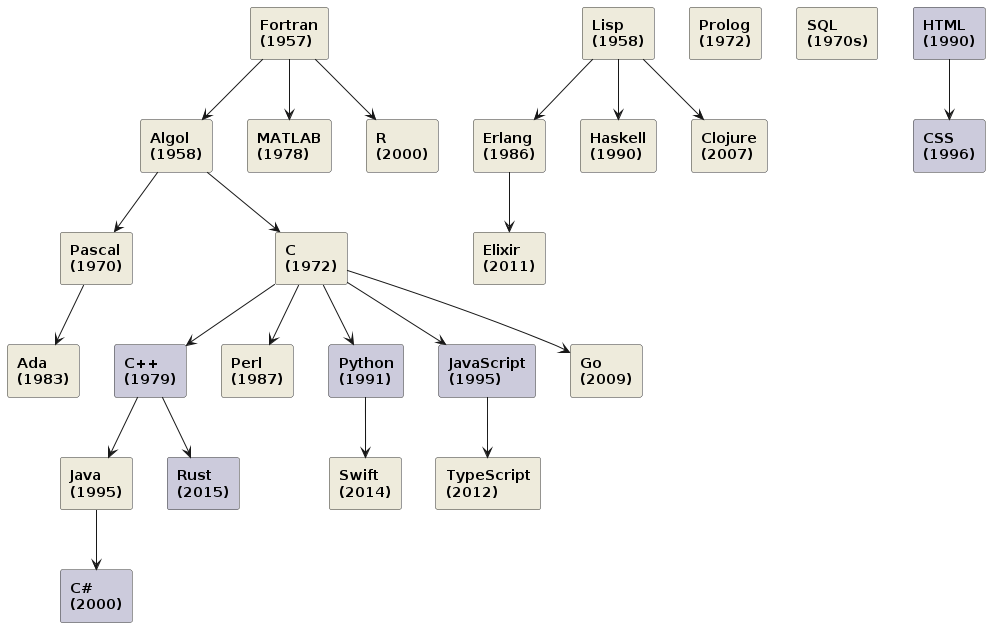
Fig 1. Language History
Programming Language:
Text that creates an executable, like Rust, or declares a structure or style, like HTML.
We choose a language based on application needs:
Text that creates an executable, like Rust, or declares a structure or style, like HTML.
- Security: Rust or C#
- Performance: Rust or C++
- Available libraries: Python or Rust
- Specialized domain: JavaScript, HTML, and CSS
- Ease of construction: Python
- Facilities for making GUIs: C#, Python
1.0 Language History
more details with help from ChatGPT 4.0
-
Fortran (1956)
Language developed by John Backus at IBM for scientific and engineering computation.
Description: FORTRAN (FORmula TRANslation) is imperative (describing how the computation is to be carried out) and procedural (based on function definitions) compiled language.
Features: It emphasizes mathematical syntax, supports multi-dimensional arrays, and produces highly optimized machine code. -
Algol (1958)
Algol was developed by John Backus, Peter Naur, and Friedrich Bauer, sponsored by ACM and GAMM.
Description: Algol (ALGOrithmic Language) is compiled, imperative, and introduced block structured code.- Block Structure is used by many modern languages, including Rust, C++, C#, Python, and JavaScript.
- Block structure defines function scope and scopes for loops and branches in a function's code.
- It provides very efficient use of stack memory by allocating memory as the thread of execution enters a scope, to hold parameters and local variables, and returns the allocated memory when execution leaves the scope. Essentially, each allocation is a scratchpad for temporary computations.
-
C++ (1979)
Developed by Bjarne Stroustrup at Bell Labs to add object-oriented features to the C language.
Description: General-purpose, multi-paradigm compiled language, designed for high performance and large software systems.
Features: C++ is imperative, object-oriented, and provides templates for generic programming. It provides constructors and destructor to allocate and return resources when the thread of execution enters and leaves a scope. Unique among all the programming languages, C++ has an internal meta-language used to make certain types of computations during compile-time. That is called template-metaprogramming. -
Rust (2015)
Developed by Graydon Hoare et. al. at Mozilla to provide memory-safe computation and eliminate data races for multi-threaded programs.
Description: Rust is a compiled, statically typed language that is largely imperative but adds some functional programming with iterators.
Features: Rust has a strong type system and ownership model that supports memory safety without using garbage collection. High level constructs like traits and iterators compile to efficient machine code. Rust provides pattern matching and enumerations that can hold instances of another type. Rust comes equipped with a tooling ecosystem that supports efficient production and testing of programs. -
C# (2000)
Developed by Anders Hejlsberg, et. al. at Microsoft to be multi-paradigm, object-oriented, and type safe as part of the .NET platform and compiles to Common Intermediate Language (CIL) for execution on the Common Language Runtime (CLR) virtual machine.
Desicription: Initially designed to support Windows development, it supports object-oriented, functional, event-driven, concurrent, and component-based programming.
Features: provides strong static typing, garbage collection, classes, interfaces, and properties. C# incorporates a data language called LINQ, delegates and events, pattern matching, attributes and reflection for making queries about an object's types and methods at run-time. The current version can generate code for Windows, Linux, and macOS and its compiler runs on those platforms as well. -
Python (1991)
Developed by Guido van Rossum at CWI in the Netherlands, Python is high-level, interpreted, multi-paradigm programming language.
Description: Python has concise and readable syntax, defining scopes with white-space indentations. It is dynamically typed, so many errors are not caught until run-time. Features: High-level data types: lists, dictionaries, sets, and strings, with powerful methods. Python programs are structured with modules and packages providing a productive development environment. Its interpreted execution provides quick code development, but high latency and low throughput at run-time. It provides garbage collection, and runs on most platforms. -
JavaScript (1995)
Developed by Brendan Eich at Netscape Communications.
Description: High-level, interpreted, multi-paradigm programming language, most often used to build interactive web pages. All popular browsers support an execution environment for JavaScript.
Features: Standardized as ECMAScript, is dynamic and weakly typed. JavaScript supports imperative, event-driven, functional, and prototype object-oriented programming. It provides first class functions, closures, asynchronous execution, and uses the HTML DOM interface to build user-interactive operations that effect the style and structure of web pages. -
HTML (1991)
Developed by Tim Berners-Lee at CERN to support communcation between scientists at CERN.
Description: HTML (HyperText Markup Language) is declarative, the standardized markup language used to structure and display content of web pages.
Features: It defines semantics and lyout of documents (pages) using a system of tags, to guide browsers in rendering text, images, links, forms, and multimedia. -
CSS (1987)
Developed by Hakon Wium Lie and Bert Bos for W3C, to support styling web pages.
Description: CSS uses a declarative stylesheet language to define layout, color, fonts, ...
Features: CSS uses selectors to target HTML elements by tag, class, ID, and relationships. Each style starts with selector(s), then provides a braced scope with individual style rules. Each rule has a key, value structure. The key identives a style attribute, like width, and the value defines its setting. CSS has a complex inheritance structure, a box model that wrap each element in a box with border, padding, and content. It provides powerful collections using Flexbox and Grid. It provides custom reusable properties using var(--var-name) syntax.
2.0 Languages
3.0 References:
| Rust Topic | Link |
|---|---|
| Rust Home Page | rust-lang.org |
| rust-lang blog | blog.rust-lang.org |
| large collection of links, articles, and code | github.com/rust-unofficial |
| C++ Topic | Link |
| C++ reference site | cppreference.com |
| Discussions, Notes, and FAQ | isocpp.org |
| Herb Sutter Blog | blog articles |
| C# Topic | Link |
| C# language docs | learn.microsft.com/dotnet/csharp |
| technical dotnet blogs | devblogs.microsoft.com/dotnet |
| Python Topic | Link |
| Python Home Page | python.org |
| Tutorials | realpython.com |
| Yasoob Khalid blog | python tips |
| JavaScript Topic | Link |
| Mozilla Dev Network (MDN) | JavaScript (MDN) |
| technical articles and blog posts | 2ality.com |
| articles and links | javascriptweekly.com |